Relation between Servers and Cloud
Hi, I'm Uma Krishna. I'm here talk about AWS Cloud Computing.
“Cloud” is used as most marketing term which will heard by us frequently.
The first question is Cloud and who discovered it and given the techniques to us? Well many years back in 2002 when Amazon was an online sales website taking off. Starting from bookseller to almost cloud buy everything from computer games, clothes, shoes etc. Amazon needed to build a huge technical infrastructure to deal with it’s growing client base, which means servers a lots of servers.
The Amazon site needs to be hosted on serval no. of servers which are grouped into a large warehouses called data centers.
Where Did Cloud come from?
To meet the increasing demand, Amazon need to maintain the tens of thousands of servers located across the globe. They realized the values of this innovation both economically and technologically.
Now, the users or developer doesn’t need to buy a stack of servers like Amazon did. They are asked to use the servers temporarily when they need or has the most visitors to their site. Then Amazon would take care of everything by making all the machines available, configuring them. Now, the developer can focus on business while Amazon mages its IT infrastructure in efficient way (pay-as-you-go) model.
AWS has currently millions of servers across the world, distributed within multiple data centers.

What sets cloud services apart from traditional hosting services where you rent servers?
The developer needs to buys or rent physical servers. Where Amazon engineers hides the severs and sells the processing power and storage. But, when you request still real server will respond to your request. A server is plugged into power supply with hard disk. Actually, we don’t know which server is responding to our request, sometimes the underlying servers will switch to different server, but the our website continues to function without any glitch.
If a hard disk fails, you can replace it, the ideology is no need to worry about the physical hardware anymore. This is were cloud computing came from. There are still servers, processors, memory and hard disks. But, instead of renting a physical server you can rent “server power”.
The cloud is frequently symbolized by the image of a cloud, implying "you can't see what's inside, but trust that it functions.
While issues are uncommon, they can still arise. Amazon, Google, and Microsoft have all experienced instances where their cloud infrastructure was unavailable for several hours due to significant technical bugs. Fortunately, this is a rare occurrence, but it is something to be aware of.
Shared Responsibilities:
The true strength of any cloud service is in relieving the client from low-level server management tasks.
Well that’s good, what happens if there’s a fault or security breach?
It all depends on AWS services we are using and type of fault that’s occurred. This is were shared responsibilities takes place.
The AWS shared responsibility model is a concept of dividing responsibilities between AWS and a Customer.
The Customer is you.
AWS's responsibilities are the security of the cloud.
Customer responsibilities are security in the cloud.
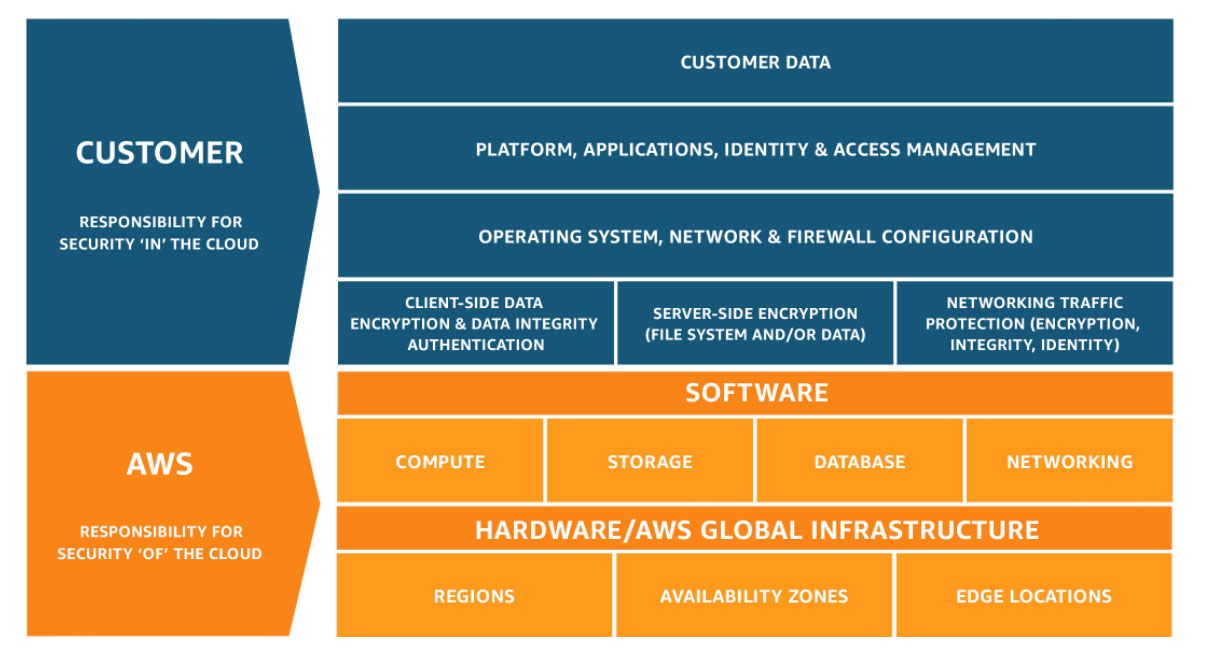
AWS’s specific responsibilities vary from one service to another (e.g., Amazon S3 or Amazon RDS). The golden rule is that if you have control of something, it’s your responsibility.
In conclusion, the evolution of cloud computing has transformed the way businesses and developers manage their IT infrastructure. By leveraging the power of cloud services, companies can focus on their core business activities without the burden of maintaining physical servers. The cloud offers flexibility, scalability, and cost-efficiency through models like pay-as-you-go, allowing users to access server power as needed. While cloud services provide significant advantages, it's important to understand the shared responsibility model, where both the cloud provider and the customer play crucial roles in ensuring security and reliability. As cloud technology continues to advance, it remains a vital component of modern digital infrastructure, offering innovative solutions to meet the growing demands of the global market.
